Yes, LinkedIn allows AI headshots. No LinkedIn rule bans AI-generated profile photos. What the rules do ban is any photo that fails to reflect your real likeness, whatever tool made it. The difference between a compliant headshot and a policy violation comes down to one word: likeness.
What LinkedIn Policy Says About AI Headshots
Official Terms of Service on Profile Photos
LinkedIn does not ban AI-generated headshots, but the LinkedIn Professional Community Policies require your profile photo to accurately reflect your real physical likeness.
The exact clause sits in the "Be Trustworthy" section: "Do not use an image of someone else, or any other image that is not your likeness, for your profile photo." Read it twice. It says nothing about how the photo was made. A studio camera, a phone, or a generator trained on your own selfies all pass the same single test: is the face in the photo actually your face?
The synthetic-media clause that people usually cite is aimed at deceptive posts, such as a video of a person saying something they never said without disclosure. It does not target a profile photo of the real account holder. The entire "is AI allowed" debate asks the wrong question, because likeness is the only rule that applies.
Citation Capsule: LinkedIn allows AI headshots because its Professional Community Policies regulate likeness, not production tools: any profile photo that genuinely represents the account holder complies in 2026, whether a studio camera, a phone, or an AI generator produced it.
The Line Between Permissible Enhancements and Impersonation
Enhancing a real photo of yourself with AI is safe, while generating a synthetic face that does not resemble you violates LinkedIn's identity rules and can get the photo removed or the account restricted.
The compliant side of the line covers lighting correction, background replacement, wardrobe cleanup, and moderate skin retouching on a photo that started as you. The violation side covers a generated face with different eyes, a reshaped jaw, or vanished glasses, because that output is no longer your likeness. A heavily beautified phone photo that erases your actual features sits closer to a violation than a faithful AI portrait.
LinkedIn enforces the likeness rule through removal, and enforcement is not hunting for AI. It is hunting for images that are not you.
How Recruiters React to AI Generated Headshots
Spotting the Uncanny Valley Effect in Professional Profiles
Experienced recruiters spot low-quality AI headshots far less often than they think, but they react strongly the moment they believe a photo is synthetic.
In comprehensive industry studies, recruiters correctly identified AI headshots only 39.5% of the time—worse than a coin flip—yet 80% believed they had guessed accurately. In blind comparisons, 76.5% actually preferred the AI headshots over real photos. The risk arrives at disclosure: 66% said they would be put off a candidate once they recognised an AI headshot, and 88% believe candidates should disclose AI use.
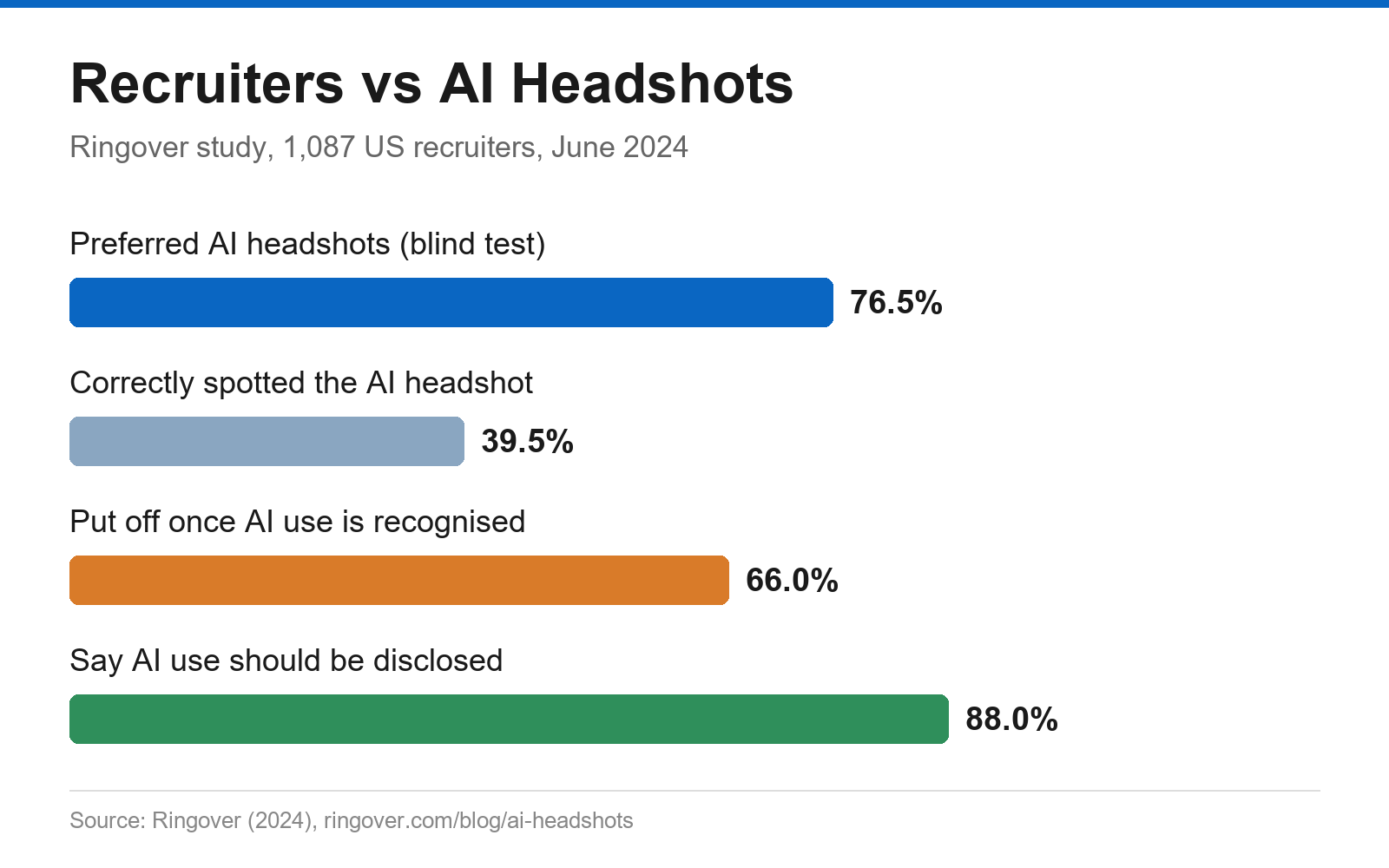
Citation Capsule: Independent recruiter surveys found that 76.5% preferred AI headshots over real photos in blind comparisons, recruiters identified AI headshots correctly only 39.5% of the time, and 66% said they would be put off a candidate once they recognised AI use.
The practical reading is simple. Recruiters do not punish AI. They punish the uncanny: plastic skin, odd eyes, a face that does not match the person on the video call.
Industry Differences in Photo Expectations
Tech startups and creative agencies generally welcome polished AI portraits, while finance, law, and other conservative fields read heavy retouching as untrustworthy.
Conservative industries weight trust signals more heavily, and data shows that recognised AI use damages trust once discovered. Creative fields weight presentation quality, where the same blind-tested AI portraits outperformed real photos.
The safest calibration is identical in every industry: keep the photo faithful to your face, and keep the polish invisible.
Practical Guide to Creating a Compliant LinkedIn Headshot
Transforming a Selfie into a Studio Quality Portrait
You can turn a casual phone selfie into a compliant, studio-grade LinkedIn headshot by fixing the light and the background while leaving your facial landmarks untouched.
- Start from a sharp, front-facing selfie with natural expression. The face must stay yours.
- Correct the environment, not the anatomy. Replace the cluttered background and balance the lighting. Keep pores, asymmetries, and your real hairline.
- Export for the circular crop. LinkedIn displays profile photos as a circle, so keep your face filling roughly 60% of the frame at 400 x 400 pixels or larger.
Photo Editor AI built its AI Portrait Generator for exactly this workflow. The Nano Banana 2 Pro engine retouches lighting and background while preserving facial structure, verified through 1,000+ quality tests. Processing takes 15 to 30 seconds, outputs carry no watermarks, and uploads are deleted permanently within 60 minutes under a zero AI-training policy.
Key Mistakes to Avoid When Polishing Your Portrait
Over-smoothing skin and altering facial proportions are the two mistakes that make a LinkedIn headshot look fake to recruiters.
When recruiters explained what gave an AI headshot away, the top tells were glitching features (54.8%), an overly flawless look (43.6%), and an overly posed style (34.3%). Notice what is missing from that list: the photo being made by AI. The tells are quality failures, not origin markers.
Citation Capsule: Recruiter studies flagged glitching features (54.8%), an overly flawless look (43.6%), and an overly posed style (34.3%) as the top AI giveaways, so subtle retouching of a real selfie survives scrutiny far better than a fully generated face.
The mistakes to avoid follow directly. Do not erase every pore. Do not let the tool swap your glasses, reshape your jaw, or change your eye spacing. Keep the result one notch above your everyday appearance, not ten.
What to Do Next
Steps to Audit and Update Your Current LinkedIn Photo
Audit your current LinkedIn photo with three checks: it matches how you look on a video call, it stays sharp inside the circular crop, and your editing tool protects your uploads.
First, the likeness check. Open a video call and hold your profile photo next to your live image. If a colleague would not instantly match the two, the photo fails LinkedIn's core rule. Second, the technical check. Zoom the photo to the small circular crop LinkedIn actually displays and confirm your face stays clear and fills roughly 60% of the frame. Third, the privacy check. Any tool you upload to should state a deletion window; Photo Editor AI deletes uploads permanently within 60 minutes and never trains on user photos.
Citation Capsule: Auditing a LinkedIn headshot in 2026 takes three checks: the photo matches how you look on video calls, it stays sharp inside the circular crop at 400 x 400 pixels, and your editing tool deletes uploads within a stated window.
If your current photo fails any check, retake a clean selfie and run it through a compliant retouching workflow rather than a full regeneration. Related reading lives on the Photo Editor AI blog.
Ready to transform your photos?
Try Photo Editor AI today. Upload your image, choose your mode (like the Ghibli Style Converter or AI Portrait Generator), and download your crisp, watermark-free image in less than 30 seconds. Your photos are private, secure, and deleted permanently within 60 minutes.
Generate Compliant HeadshotFrequently Asked Questions
Can LinkedIn detect AI headshots?
LinkedIn has not announced any public AI detection system for profile photos. Enforcement relies on human review and user reports when an image clearly misrepresents the account holder's real identity.
What is LinkedIn's official policy on profile photos?
LinkedIn requires your profile photo to be an accurate representation of your physical likeness. Enhancing a real photo with AI is compliant, but using a synthetic face of another person violates policy.
Do recruiters reject candidates who use AI headshots?
Recruiters rarely reject candidates simply for using AI; 76.5% preferred AI headshots in blind testing. However, 66% report being put off if the photo looks fake, overly smoothed, or fails to match the person on video calls.
How can I tell if my AI headshot looks too fake?
Hold the image next to your live video camera. If your skin looks like plastic, natural asymmetries are gone, or your jawline is drastically altered, recruiters will notice the uncanny effect.
What is the best way to make a compliant AI headshot?
Start from a sharp smartphone selfie, then use a tool like Photo Editor AI to refine lighting, clean up wardrobe, and replace cluttered backgrounds while locking your natural facial landmarks.