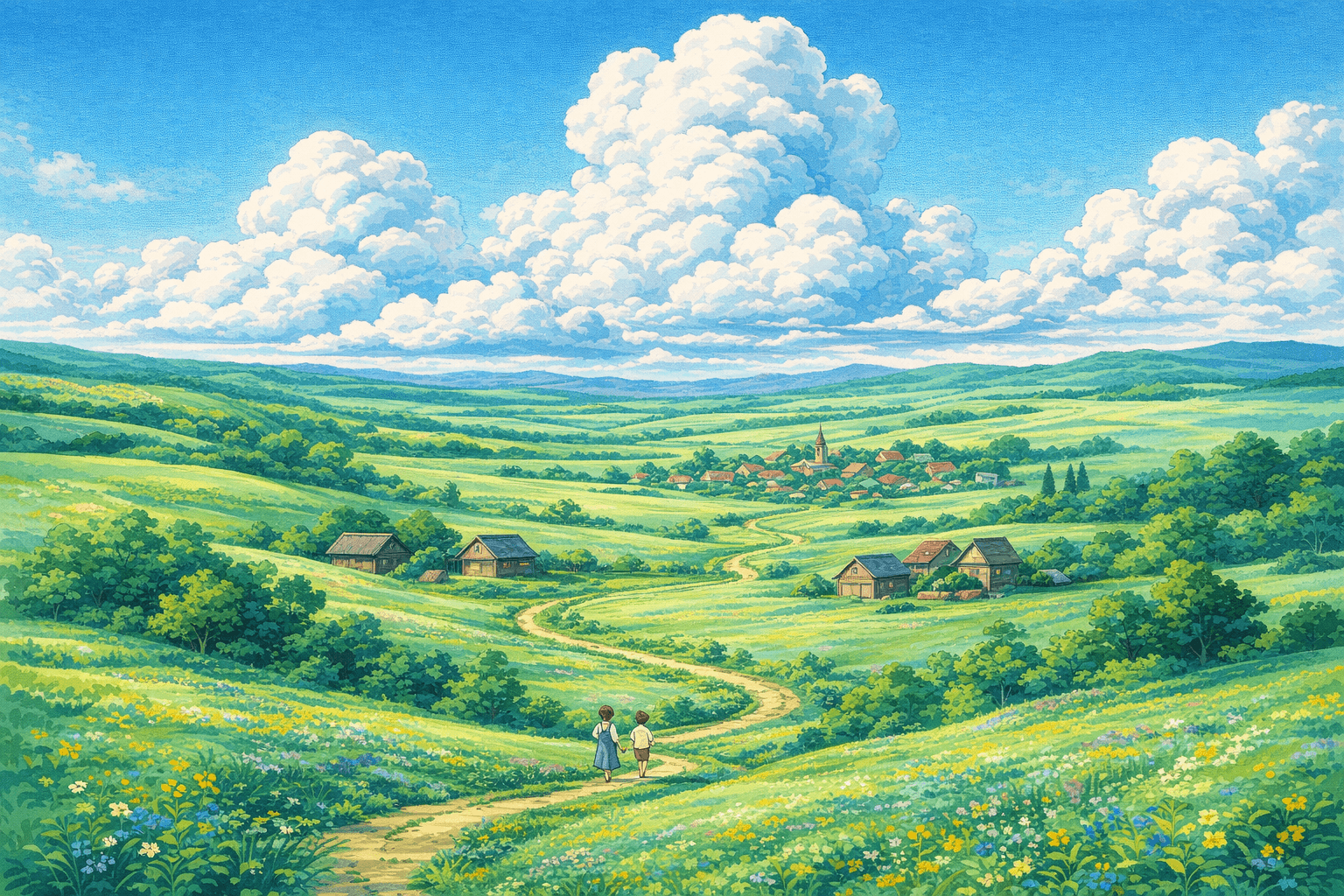
Ghibli backgrounds often feel comforting and immersive because they do several jobs at once. They establish a real place, guide the eye, suggest a history, and set an emotional temperature. A path is not only a route for a character; its weeds, puddles, shadows, and distant buildings can tell you what kind of world the character inhabits.
There is no single Ghibli background recipe, and “feel good” is a viewer response rather than a measured property. The following features are useful ways to look closely at the art.
1. The place looks observed
Rooms contain objects that belong together. Plants grow in plausible directions. Roads have uneven edges. Weather changes the color of distant surfaces. These details do not need to be photorealistic. They make the setting specific enough to imagine walking through it.
The Ghibli Museum describes background art as the base material that creates the world where characters live. Its account of the background-art process points to paper, paint, water, light, shadow, and hue. That is a stronger explanation than saying the backgrounds are simply “pretty”: material choices help turn an abstract setting into a place.
2. Layers create depth
A convincing background usually separates foreground, middle distance, and far distance. Edges may soften as they recede. Colors can become lighter or less contrasty. Overlapping leaves, fences, roofs, and hills give the eye a route through the frame.
This depth does not require every area to be equally detailed. A quiet patch of sky or a simple wall can give the more important forms room to read.
3. Light tells you when and where you are
Ghibli scenes often make light legible. A window warms a floor. Cloud cover cools a road. Late sun catches a field while the side of a house stays in shade. The result can feel emotionally clear even when the palette is subtle.
Look for the light source first. Then follow its effect across materials: water reflects differently from wood, leaves, or plaster. Consistent light helps the scene feel coherent.
4. Texture suggests touch
Painted surfaces can imply bark, stone, dust, cloth, or damp air without drawing every grain. Slight variation in color keeps a large area from looking like a flat digital fill. Texture also signals scale: a rough wall and a soft cloud do different storytelling work.
Texture should support the scene. If every surface is equally busy, the eye loses the composition’s priorities.
5. Everyday objects make fantasy believable
Cooking tools, bicycles, laundry, school bags, signs, and worn paths connect extraordinary events to ordinary life. These objects do not need an explicit explanation. Their presence suggests routines that continue before and after the scene.
That attention to daily life is one reason a fantastical setting can feel safe or familiar. It is a narrative effect of specificity, not proof that viewers experience identical emotions.
6. Composition leaves room to breathe
Many memorable backgrounds frame a character with architecture, foliage, or open sky. The empty space can slow the eye and make a gesture more legible. A crowded frame can create excitement; a quieter frame can create observation. Neither is automatically better.
A practical way to study a background
Choose one frame and identify:
- the closest and farthest visible planes;
- the main light source and three surfaces it affects;
- one texture that establishes weather or material;
- one ordinary object that suggests a routine;
- the area of least detail and what it lets you notice.
This method works for film study, illustration, and image prompting. If you are describing a generated image, specify the place, weather, layers, light direction, and material cues instead of asking for “beautiful Ghibli background” alone.
FAQ
Are all Ghibli backgrounds watercolor?
No single medium describes every production stage or film. The museum’s material discusses hand painting and also notes that digital tools have increased in background work. “Painted” is a useful visual description, not a universal technical rule.
Why do backgrounds matter so much?
They create the world in which the characters live, establish mood, and help the audience understand space. Their importance varies by scene and film.
Do Ghibli backgrounds calm the brain?
That is too broad a claim without a specific study and population. You can describe the observable choices—natural settings, quiet composition, and readable light—without turning a subjective response into a medical or psychological result.