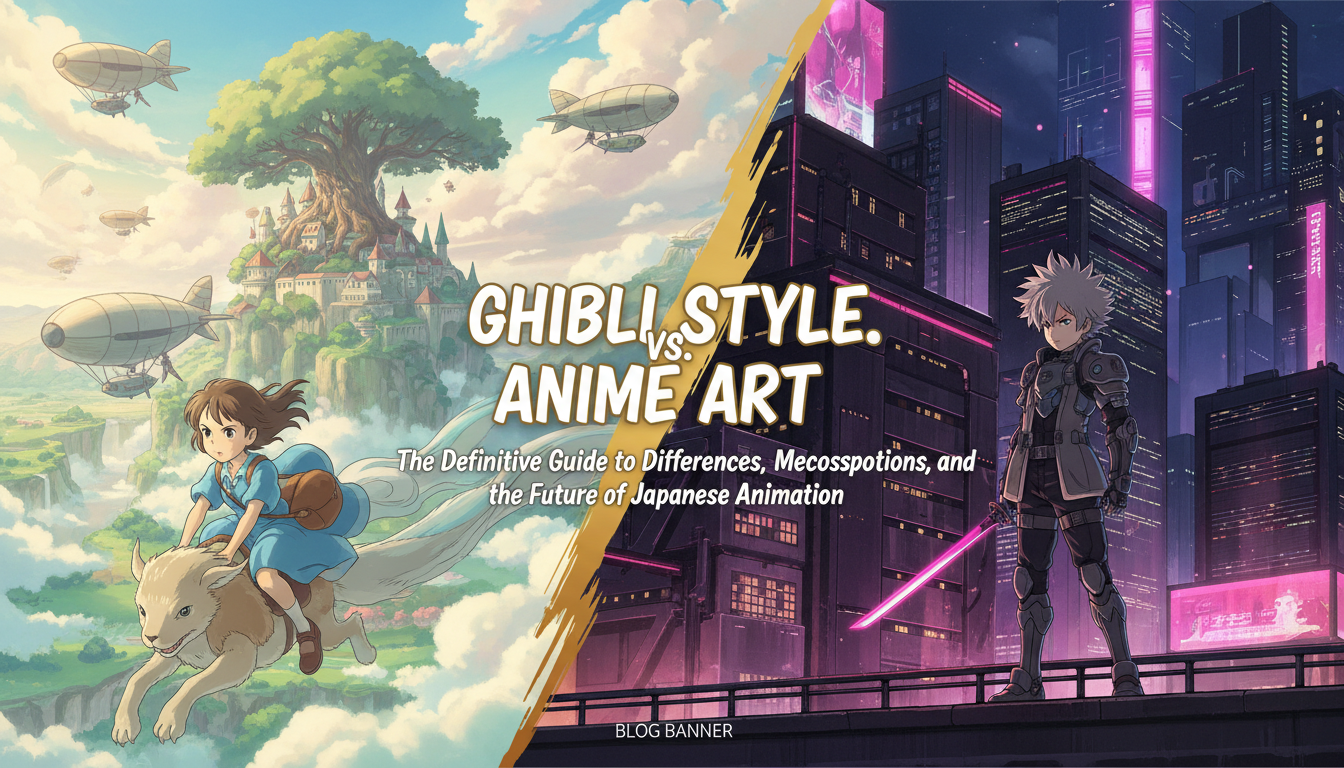
Yes. Studio Ghibli films are anime: they are Japanese animated films made within the wider anime tradition. “Anime” is the broad category. “Ghibli” identifies a studio and the body of work associated with it. The useful comparison is therefore not Ghibli versus anime as if they were separate media. It is Ghibli’s recurring visual and storytelling choices compared with other anime traditions.
That distinction matters when you search for an AI image prompt or try to describe an artwork. Anime can mean many things: a quiet slice-of-life film, a flat graphic comedy, a high-energy action series, or a painterly feature. There is no single “standard anime” look.
What is anime?
Anime is a common English label for animation from Japan, and it is also used for animation influenced by Japanese production and visual conventions. The category covers many genres, studios, budgets, techniques, and eras. Line weight, eye shape, color, motion, and background detail can change dramatically from one work to another.
Some television productions use limited animation, such as holding a background while selected parts of a character move. That is a production approach, not a definition of anime and not evidence that every anime title looks flat or rushed.
What makes Ghibli recognizable?
“Ghibli style” is an informal description, not a single technical standard. Viewers often associate Studio Ghibli films with hand-drawn character animation, observed environments, natural light, soft but deliberate color, and scenes that allow ordinary actions to unfold. These are tendencies across a body of work, not rules that every film or frame follows.
The Ghibli Museum’s account of background art is useful here. It describes backgrounds as the material that creates the world in which characters live and points to the interaction of paper, paint, and water in hand-painted work. That helps explain why a Ghibli scene can feel lived-in: the setting carries atmosphere and visual information instead of acting only as a backdrop.
For a fuller definition of the term, see what Ghibli art means.
Backgrounds: atmosphere versus visual function
Many anime productions use backgrounds primarily to establish place, support readability, or control production time. Other productions make the environment a major subject. Ghibli is often discussed in the second group, with weather, vegetation, architecture, and small signs of use contributing to the mood.
That does not make other anime backgrounds inferior or uniform. Action anime may prioritize clear shapes and contrast so movement reads quickly. A contemplative series may use detailed scenery. A comedy may simplify a room for timing. The right comparison is between the choices a work makes and the job a scene needs to do.
Characters and movement
Ghibli characters are often grounded by practical clothing, readable gestures, and proportions that make them feel like people in a physical place. Other anime may use sharper silhouettes, exaggerated eyes, elaborate costumes, or highly graphic effects. Those choices can communicate age, role, emotion, or power at a glance.
Neither approach is a requirement. Anime character design is a large spectrum, and individual directors and studios borrow from one another.
Pacing and “ma”
Ghibli films are known for giving attention to pauses, routines, travel, meals, weather, and quiet observation. Some writers connect this use of breathing room with the Japanese idea of ma. It is safer to treat that as an interpretive lens than as a universal formula: a film’s pacing comes from its script, direction, editing, sound, and performances together.
Other anime can be slow, reflective, or atmospheric too. Conversely, a Ghibli film can contain action and suspense. The contrast is about emphasis, not a fixed boundary.
Choosing words for an AI prompt
Start with the visual result you want rather than treating “anime” as a complete brief. Describe the subject, setting, time of day, palette, line treatment, background detail, and mood. For example: “a small train station after rain, hand-drawn 2D animation, soft natural light, layered painted background, restrained colors, quiet evening mood.”
If you want a different anime direction, name it: “bold graphic shapes, high contrast, dynamic foreshortening, clean cel shading.” These descriptions are clearer than “standard anime,” which can point to many different references.
FAQ
Is Ghibli anime?
Yes. Studio Ghibli films are part of anime. “Ghibli” is a narrower studio and aesthetic reference; “anime” is the wider category.
Is Ghibli a separate art style?
It is commonly used as shorthand for recurring choices associated with Studio Ghibli, but it is not a universal style specification. Individual films and artists differ.
Why do Ghibli backgrounds feel distinctive?
They often give the environment careful observation, color, texture, and narrative attention. The Ghibli Museum’s background-art material supports that craft-focused observation.
Can an AI tool reproduce a Ghibli film?
An image model can produce related high-level traits such as a painted background or warm natural light. A generated image is not the same as the artists’ process, direction, or a film’s complete visual language. Describe traits and composition, and review the output critically.